IBM launched the 2025 Quantum Developer Conference (QDC) with a clear message: quantum advantage is no longer a distant vision. It is becoming a measurable, verifiable milestone — and the company is preparing the hardware and software needed to scale it into real-world impact.
Source : IBM Official Site
During its annual State of the Union address, IBM unveiled new processors, software upgrades, and research tools designed to help developers move from experimental demonstrations to early, practical quantum applications.
A New Framework for Quantum Advantage
IBM highlighted three categories where the first credible signs of quantum advantage are beginning to appear: observable estimation, variational algorithms, and problems that can be efficiently verified by classical methods. Although the company believes the community has not yet achieved true advantage, it introduced an open Quantum Advantage Tracker to monitor and evaluate potential breakthroughs.
Nighthawk: IBM’s New 120-Qubit Workhorse
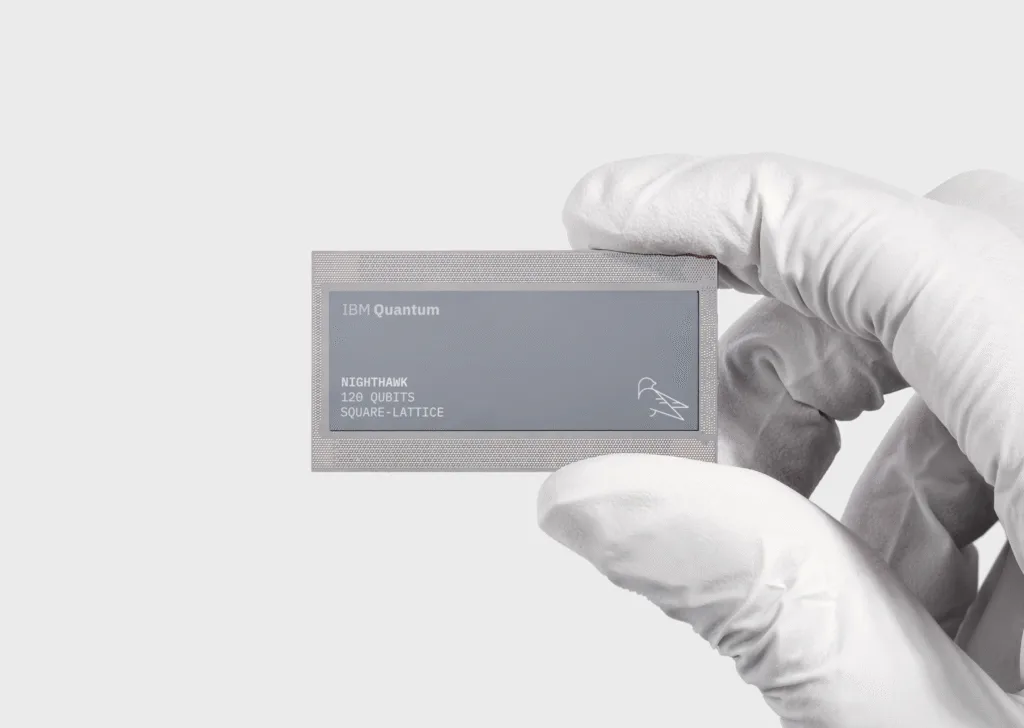
The centerpiece of the announcements was IBM Quantum Nighthawk, a 120-qubit processor featuring a new square qubit layout. With 218 couplers and fewer required SWAP gates, Nighthawk supports circuits that are 30 percent more complex than those possible on previous generations.

Source : IBM Official Site
IBM plans to scale Nighthawk through multiple revisions, eventually supporting up to 15,000 quantum gates. A 5,000-gate version is expected by the end of 2025.
Heron r3 Sets a New Performance Record
IBM also introduced the latest revision of its Heron chip, which delivers the company’s lowest two-qubit error rates to date. The Heron fleet now reaches 330,000 CLOPS, allowing utility-scale experiments to run more than 100 times faster than just two years ago.
Qiskit Evolves for Hybrid Workloads
On the software side, IBM’s open-source Qiskit platform received major upgrades. Version 2.2 delivers dramatic improvements in circuit transpilation speed, while a new package called Samplomatic gives developers fine-grained control over circuit regions and error-mitigation techniques.
IBM also demonstrated large-scale dynamic circuits, achieving up to 25 percent more accurate results and sharply reducing gate counts on 100-plus qubit workloads.
For high-performance computing users, Qiskit now offers a C API and C++ interface, enabling deeper integration between quantum and classical systems.
Progress Toward Fault-Tolerant Quantum Systems
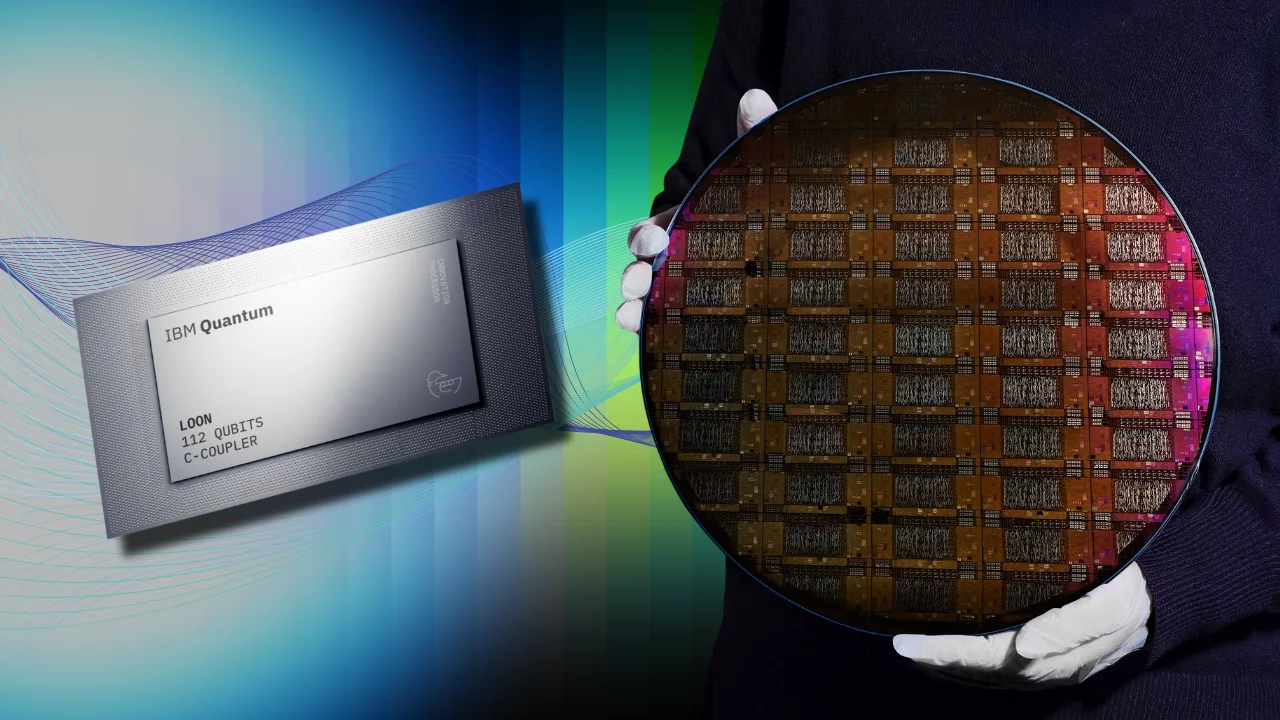
As IBM builds tools for near-term advantage, it is simultaneously advancing toward fault-tolerant quantum computing. This includes manufacturing chips on 300mm wafers to accelerate R&D and the development of IBM Quantum Loon, a proof-of-concept processor that integrates long-range couplers, multi-layer routing, and fast reset mechanisms for future error-correcting architectures.
IBM also announced a major milestone in decoding technology: its RelayBP algorithm, implemented on an AMD FPGA, can now decode errors in under 480 nanoseconds — significantly faster than competing solutions.
A Pivotal Moment for the Industry
With new hardware, improved software, and open benchmarking tools, IBM believes the community is entering one of the most important phases in the history of quantum computing. The company’s vision for 2025 and beyond focuses on scaling quantum advantage responsibly, collaboratively, and with clear validation standards.